

Watercolor's Primary Characteristic Is Its
Do You Know the four Central Properties of Watercolor Pigment?
While at that place's aught incorrect with experimenting with watercolor paints, knowing their qualities and characteristics (and how they effect your painting) tin help yous create purposeful, compelling compositions. Read on to learn the basics watercolor properties before y'all kickoff your next masterpiece.
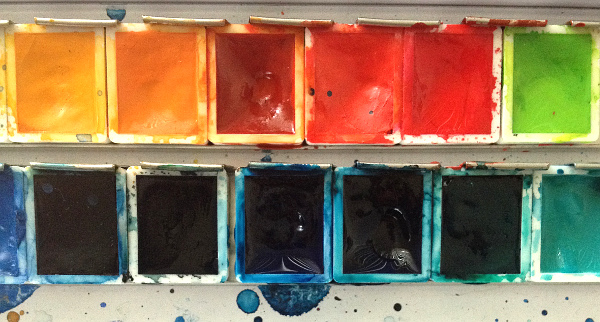
What exactly are watercolor paints?
Watercolor paints basically consist of two principal components: pigment and binding medium.
Pigments
Finely basis pigments, which give the paints their colour, can be either organic or inorganic.
Organic pigments incorporate carbon, and they can be derived naturally from living matter or produced synthetically. For example, carmine used to be extracted from stale insects, while indigo and Indian yellow were originally made from plants. Nowadays, most natural organic pigments take been replaced with synthetic ones.
Inorganic pigments comprise metals, and they can be mined directly from the Globe (examples include ochres, siennas and umbers), of manufactured in a lab (similar cobalt blueish and cadmium xanthous).
Bounden mediums
A binding medium is natural gum arabic or synthetic compounds. The binding medium is what makes watercolor paints different from other types of paint: For instance,oil paints are made with linseed oil and acrylic paints are fabricated with acrylic polymer emulsion.
Manufacturers also add other necessary ingredients, such as plasticizer (usually glycerin), humectant (sugar syrup or dearest), wetting agent and preservatives.
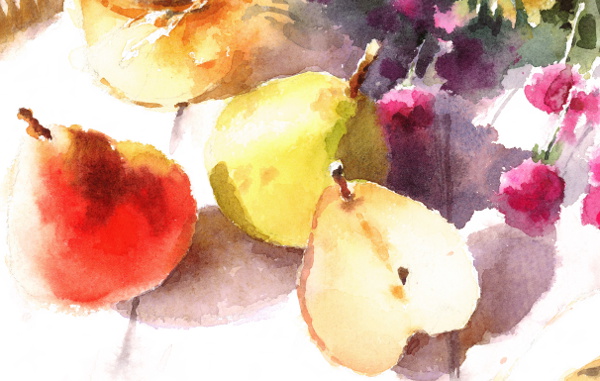
The beauty of watercolor lies in its unique qualities.
There are 4 bones characteristics of watercolor paints every artist should know well-nigh.
1. Transparency and opacity
Watercolor paints autumn into i of four transparency categories:
- Transparent
- Semi-transparent
- Semi-opaque
- Opaque
Transparent watercolors allow the light to come through and reverberate from the white paper, which makes the colors glow. Opaque watercolors, on the other hand, block the calorie-free from shining through, so they wait thicker and somewhat cloudy. Semi-opaque and semi-transparent are somewhere in-between.
Transparency examination
To find out where your paints fall on the spectrum of transparent to opaque, y'all can do a simple exam. Draw a assuming line with a blackness permanent mark; and so stroke the color over that line. Opaque colors will exist visible on the blackness line, while transparent colors will not appear.
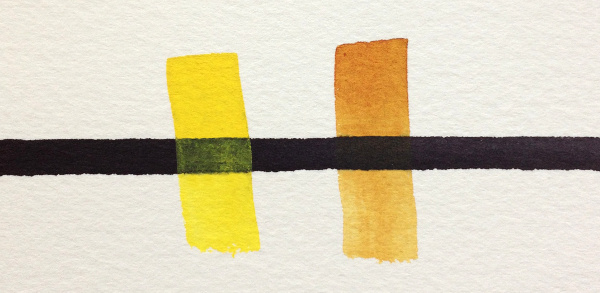
Every bit you lot tin can see from the motion picture, the cadmium lemon (on the left) is opaque, and quinacridone golden (on the right) is transparent.
2. Staining and non-staining paints
Staining watercolors immediately penetrate the fibers of the newspaper and stain it, then information technology'due south difficult or impossible to elevator the color off.
Non-staining watercolors, on the contrary, settle on the surface of the newspaper, and can be hands rewet and lifted when dry.
Staining exam
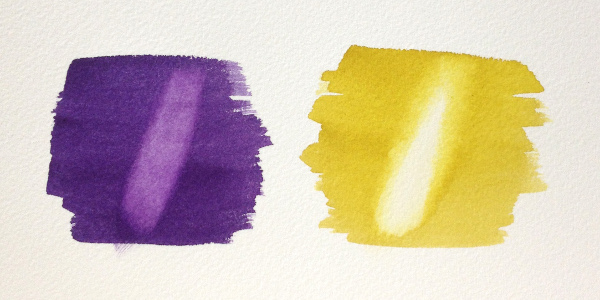
To examination your watercolors for staining quality, pigment a patch of color and let it dry. And so, try to scrape off some of the pigment with a stiff, wet castor. The corporeality of pigment that remains will tell you most the paint'south staining quality.
In the image below, the left patch is painted with winsor violet, which is made of dioxazine violet — a staining pigment. Even after trying to lift the pigment with a wet castor, some of the pigment remains.
On the right-hand side, you come across green-aureate — a non-staining pigment. After lifting some of the pigment with a wet brush, you can see the white of the newspaper again.
3. Granulating quality
Depending on the pigment, the particles in the pigment tin can be heavy or calorie-free. Watercolor paints with heavier particles tend to separate from the water and collect in the tooth of the paper.
The movie below shows ultramarine blue on the left and quinacridone gold on the right. Ultramarine is a granulating (sedimentary) paint. It looks grainy and creates a texture of its ain. Quinacridone gold, on the other hand, has smaller paint particles, and so it flows evenly over the paper.
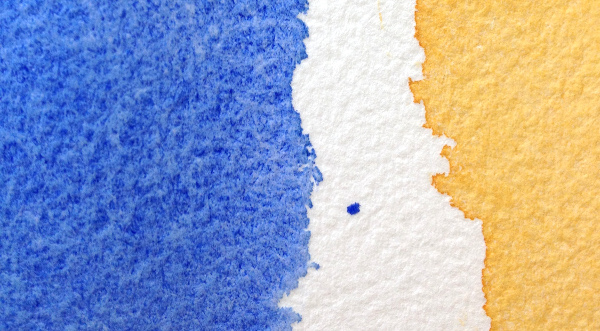
I'm a large fan of granulating paints, because it adds involvement and texture to a painting.
four. Fugitive and non-avoiding paints
The longevity of your work depends on the lightfastness of your watercolor paints. A non-fugitive paint (or one with a good lightfastness rating) will non fade over time. A avoiding paint (or 1 with poor lightfastness) will fade quickly, so it's best to avoid them.
The American Society of Testing and Materials (ASTM) established a standardized organisation that grades lightfastness on a scale from I – Excellent Lightfastness to 3 – Non Sufficiently Lightfast. Watercolors with an ASTM rating of I or 2 are considered non-fugitive, while paints with a rating of Iii are fugitive. The lightfastness rating of the paint can usually be constitute on the label.

Watercolor's Primary Characteristic Is Its,
Source: https://www.craftsy.com/post/watercolor-paints/
Posted by: clevelandwhind1981.blogspot.com
0 Response to "Watercolor's Primary Characteristic Is Its"
Post a Comment