

As Frequency Increases Wavelength Decreases
In physics, frequency and wavelength are important characteristics related to a wave bicycle. At present, what is a wave? The transfer of energy from one point to another by a disturbance or variation is known as a moving ridge. At present, the wavelength is defined as the distance between two successive points in phase with each other, whereas frequency is divers as the number of waves produced per second.
Frequency
The total number of wave cycles or oscillations produced per unit time is called the frequency (f) of a wave. It is measured in terms of Hertz (Hz) or s-i. For humans, the aural range of sound frequencies is from xx Hz to 20 kHz. Man ears cannot hear ultrasonic sounds, i.e., the frequencies in a higher place the audible range, and also infrasound, i.e., the frequencies less than the audible range.
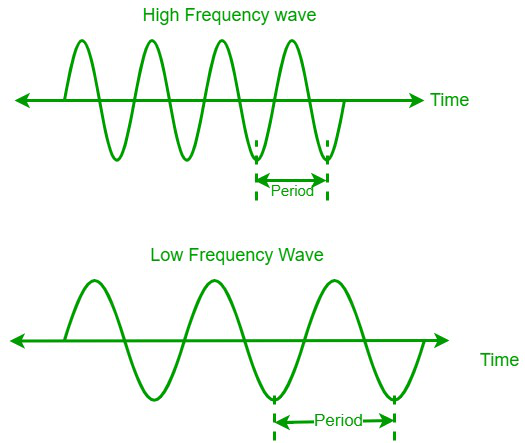
The formula for the frequency of a wave is,
Frequency (f) = i/T
Where T is the period of a moving ridge.
- The period of a wave is defined as the time taken by a wave to consummate i full bike or to complete an oscillation.
- From the formula of frequency, we can detect that the frequency of a wave is inversely proportional to its period.
1 Hertz = i oscillation/2d
Wavelength
The length of the distance between the two successive crests or troughs of a wave is called the wavelength. The crest is the highest indicate of the wave, whereas the everyman betoken of the wave is the trough. As the wavelength is a altitude or length between two points, information technology is measured in meters, centimeters, millimeters, micrometers, Angstroms, etc. It is denoted by the Greek symbol Lambda 'λ'.

The formula for the wavelength is,
Wavelength(λ) = velocity(v)/frequency(f)
⇒ λ = five/f
- The distance traveled past the wave in a unit of time is chosen the velocity of a wave or moving ridge velocity. The South.I. unit of moving ridge velocity is ms-1.
- The velocity of a wave is equal to the product of its wavelength and frequency.
v = λ × f
The distance travelled by a wave in a unit of time is equal to one wavelength.
⇒ Wave velocity (v) = Wavelength(λ)/Period(T)
Nosotros know that,
frequency (f) = ane/Period(T)
⇒ Wave velocity (v) = Wavelength(λ) × Frequency(f)
⇒ five = λ × f
⇒ λ = 5/f
How does the wavelength of a wave change when frequency decreases when frequency increases?
Answer:
Let'southward consider a thread that is tied to an cease. Now hold the other end of the rope and oscillate it faster, resulting in higher frequency waves. We can also observe that the waves are produced with a shorter wavelength. Hence, we can describe the conclusion that there is a human relationship between wavelength and frequency.
From the equation of the wavelength, we tin can tell that the wavelength of a wave is inversely proportional to its frequency, i.east., as the frequency of a wave increases, its wavelength decreases. Similarly, equally the frequency of a moving ridge decreases, its wavelength increases.
λ ∝ 1/f
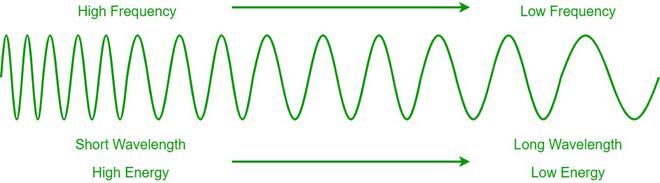
For example, allow's consider a wave whose new frequency is two times its former frequency. Now, what volition be the new wavelength of the wave?
Given data,
Let λ and λ' be the old and new wavelengths of the light moving ridge.
Allow f exist the old frequency of the wave.
Now, the new frequency of the moving ridge = 2f
Wavelength (λ) = Velocity/Frequency
The velocity of the wave remains abiding.
⇒ λ ∝ 1/f
⇒ λ1/ λ2 = f2/ f1
⇒ λ/λ' = (2f)/f = 2
⇒ λ' = λ/2
Hence, the new wavelength of the wave is half of the onetime wavelength.
Therefore, as the frequency of a wave increased, its wavelength decreased.
Therefore, as the frequency of a wave decreased, its wavelength increased.
- A wave with a loftier frequency has a short wavelength and loftier energy.
- A moving ridge with a low frequency has a long wavelength and low free energy.
Sample Problems
Problem i: Two sound waves are traveling through the air at the same speed. If a wave whose frequency is 45 kHz has a wavelength of 7.5 mm, then find the frequency of the moving ridge whose wavelength is 100 nm.
Solution:
Given data,
The speed of both the waves is equal ⇒ v1 = fivetwo = v, where v is the velocity of a sound wave
The wavelength of the outset wave ( λ1) =7.5 mm = vii.5 × 10-3 thousand
Frequency of the first wave (fane) = 45 kHz = 45 × 10iii Hz
Wavelength of 2d wave (λ2) = 100 nm = 100 × ten-9 1000
Frequency of the second wave (f2) =?
Wavelength (λ) = Velocity/Frequency
⇒ λ ∝ 1/f
⇒ λ1/ λ2 = ftwo/ f1
⇒ (7.v × 10-iii)/(100 × 10-9) = f2/(45 × 103)
⇒ ftwo = [(7.five × 10-3) × (45 × 103)]/(100 × 10-9)
⇒ f2 = 33.75 GHz
Hence, the frequency of the wavelength of 100 nm is 33.75 GHz.
Therefore, as the wavelength of a wave decreased, its frequency increased.
Trouble 2: A light wave is traveling in a vacuum. What will exist the new wavelength of the wave if the new frequency of the wave is one-fifth of its old frequency?
Solution:
Given data,
Let λ and λ' exist the old and new wavelengths of the light wave.
Let f be the old frequency of the wave.
Now, the new frequency of the wave = f/5
Wavelength (λ) = Velocity/Frequency
The velocity of the moving ridge remains constant.
⇒ λ ∝ 1/f
⇒ λ1/ λii = ftwo/ f1
⇒ λ/λ' = (f/v)/f = 1/5
⇒ λ' = 5λ
Hence, the new wavelength of the wave is v times the old wavelength.
Therefore, as the frequency of a moving ridge decreased, its wavelength increased.
Problem 3: Two sound waves traveling through water at the aforementioned speed. If a wave whose frequency is 3 MHz has a wavelength of 100 m, then find the wavelength of the wave whose frequency is four.5 kHz.
Solution:
Given data,
The wavelength of the first wave ( λi) = 100 m
Frequency of the outset moving ridge (f1) = 3 MHz = 3 × x6 Hz
Frequency of the second wave (fii) = 4.five kHz = 4.5 × ten3 Hz
The wavelength of the second wave ( λ2) = ?
Speed of both the waves is equal ⇒ vone = five2 = v
Wavelength (λ) = Velocity/Frequency
⇒ λ ∝ 1/f
⇒ λ1/ λii = f2/ f1
⇒ 100/ λ2 = (4.5 × tenthree)/(three × 10half-dozen)
⇒ λ2 = (3 × ten6 × 100 )/(four.5 × 103) = 66.67 km
Hence, the wave of frequency iv.v kHz wavelength is 66.67 km.
Therefore, equally the frequency of a wave decreased, its wavelength increased.
Problem 4: A light wave is traveling in a vacuum. What will be the new wavelength of the moving ridge if the new frequency of the wave is three times its old frequency?
Solution:
Given information,
Let λ and λ' be the old and new wavelengths of the light wave.
Allow f be the former frequency of the wave.
Now, the new frequency of the moving ridge = 3f
Wavelength (λ) = Velocity/Frequency
The velocity of the wave remains abiding.
⇒ λ ∝ 1/f
⇒ λane/ λ2 = ftwo/ fone
⇒ λ/λ' = 3f/f = 3
⇒ λ' = λ/3
Hence, the new wavelength of the moving ridge is 1-third of the former wavelength.
Therefore, equally the frequency of a wave increased, its wavelength decreased.
Problem v: A light wave is traveling in a vacuum. What will be the new frequency of the wave if the new wavelength of the wave is iv times its old wavelength?
Solution:
Given data,
Allow f and F be the old and new frequencies of the low-cal wave.
Let λ be the onetime wavelength of the wave.
At present, the new wavelength of the moving ridge = 4λ
Wavelength (λ) = Velocity/Frequency
The velocity of the wave remains abiding.
⇒ λ ∝ 1/f
⇒ λ1/ λ2 = f2/ f1
⇒ λ /4λ = F/f
⇒ F/f = 1/4 ⇒ F = f/iv
Hence, the new frequency of the wave is one-quaternary of the old frequency.
Therefore, as the wavelength of a wave increased, its frequency decreased.
Trouble 6: 2 sound notes produced by a tuning fork are traveling at the same speed. If a wave whose frequency is 6 kHz has a wavelength of 100 mm, and then detect the wavelength of the wave whose frequency is five.iv kHz.
Given data,
The wavelength of the first moving ridge ( λ1) = 100 × 10-3 thousand = 0.1 m
Frequency of the beginning wave (fone) = 6 kHz = 6 × xiii Hz
Frequency of the second wave (ftwo) = 5.4 kHz = 5.iv × 103 Hz
The wavelength of the 2nd moving ridge ( λtwo) =?
Speed of both the waves is equal ⇒ v1 = 5two = v
Wavelength (λ) = Velocity/Frequency
⇒ λ ∝ one/f
⇒ λ1/ λtwo = f2/ f1
⇒ (0.one)/ λtwo = (5.iv × 10three)/(6 × 103)
⇒ λ2 = (6 × 10iii × 0.1 )/(5.4 × 10iii) = 0.111 1000 = 111 mm
Hence, the wave of frequency 4.5 kHz wavelength is 111 mm.
Therefore, as the frequency of a wave decreased, its wavelength increased.
Trouble 7: If the new frequency of an electromagnetic wave is two-thirds of its old frequency, and then what will be the new wavelength of the wave?
Solution:
Given data,
Let λ and λ' exist the sometime and new wavelengths of the light moving ridge.
Permit f be the old frequency of the moving ridge.
At present, the new frequency of the moving ridge = (2/three)f
Wavelength (λ) = Velocity/Frequency
The velocity of the wave remains abiding.
⇒ λ ∝ 1/f
⇒ λ1/ λ2 = fii/ f1
⇒ λ/λ' = (2/iii)f/f = two/iii
⇒ λ' = 3λ/2 = 1.5λ
Hence, the new wavelength of the wave is three and a half times its onetime wavelength.

As Frequency Increases Wavelength Decreases,
Source: https://www.geeksforgeeks.org/what-happens-to-the-wavelength-of-a-wave-when-frequency-increases-or-decreases/
Posted by: clevelandwhind1981.blogspot.com
0 Response to "As Frequency Increases Wavelength Decreases"
Post a Comment